On March 1, 1872, President Ulysses S. Grant signed a short act of Congress, and with that signature some 2.2 million acres at the headwaters of the Yellowstone River became something the world had never seen. The act reserved the land "from settlement, occupancy, or sale under the laws of the United States" and dedicated it "as a public park or pleasuring-ground for the benefit and enjoyment of the people." There was no ceremony, and Grant, who never visited Yellowstone, left no recorded comment on what he had done. Yet that quiet signature founded an idea, the national park, that has since spread around the globe.
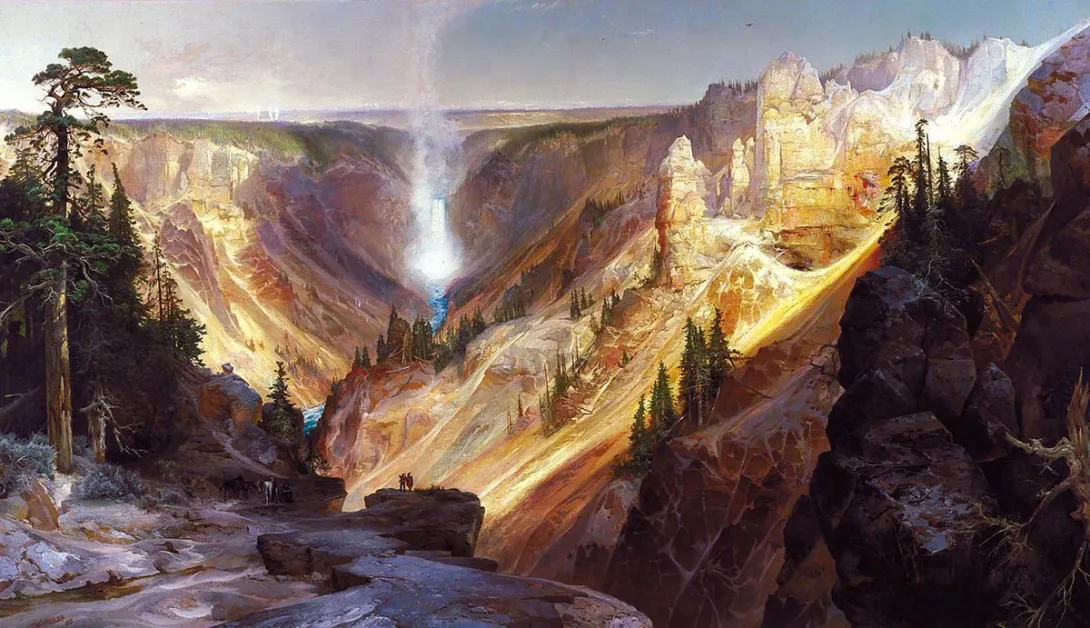
The road to Grant's desk ran through three expeditions in three years. In 1869, three private citizens, David Cook, Charles Folsom, and William Peterson, rode through the region and returned with accounts that few believed. In 1870, the Washburn-Doane expedition, a party of Montana citizens escorted by the Army, surveyed the geysers, the canyon, and the great lake, and its members came home as advocates for protecting the place. In 1871, Ferdinand V. Hayden's federally funded geological survey brought back the evidence that settled the argument: the photographs of William Henry Jackson and the paintings of Thomas Moran, images that let members of Congress see Yellowstone's wonders with their own eyes. Congress acted about six months after Hayden's party returned.
The new reserve covered roughly 3,468 square miles straddling the Wyoming, Montana, and Idaho territories. It was placed under the Department of the Interior, and its boundaries took in the geyser basins, the Grand Canyon of the Yellowstone, Yellowstone Lake, and the headwaters country between them. For all its vision, however, the act had a serious defect: Congress appropriated no money at all to run or protect the park. That empty purse shaped Yellowstone's first four decades, leaving its early superintendents with authority on paper and almost nothing in hand. The park was administered by the Department of the Interior, and it would remain a departmental orphan for a long time: the National Park Service itself was not created until the Organic Act of August 25, 1916, when Yellowstone was already forty-four years old.
Honesty requires a footnote about motives. Yellowstone's creation was not pure conservation idealism. As the historian Richard Sellers has observed, Congress was at least as interested in western tourism and railroad promotion as in preservation, and Jay Cooke's Northern Pacific Railroad, which stood to carry tourists to the park's doorstep, lobbied hard for the bill. Nor was Yellowstone the first landscape Americans had set aside: Yosemite Valley had been granted to California in 1864, and the springs at Hot Springs, Arkansas, had been reserved in 1832. Yellowstone's claim, and it is a solid one, is that it was the first national park, a reserve held by the nation itself for all of its people.
Today the words Grant signed still greet visitors, carved in stone above the Roosevelt Arch at the north entrance: "For the Benefit and Enjoyment of the People." More than 150 years later, the park he created by signature remains what the act intended, a pleasuring-ground of geysers, canyons, lakes, and wild animals that belongs to everyone, including generations who will never see it. Every national park on Earth traces its lineage back to March 1, 1872.
Photo: Thomas Moran, The Grand Canyon of the Yellowstone, 1872, Smithsonian American Art Museum (via Wikimedia Commons).