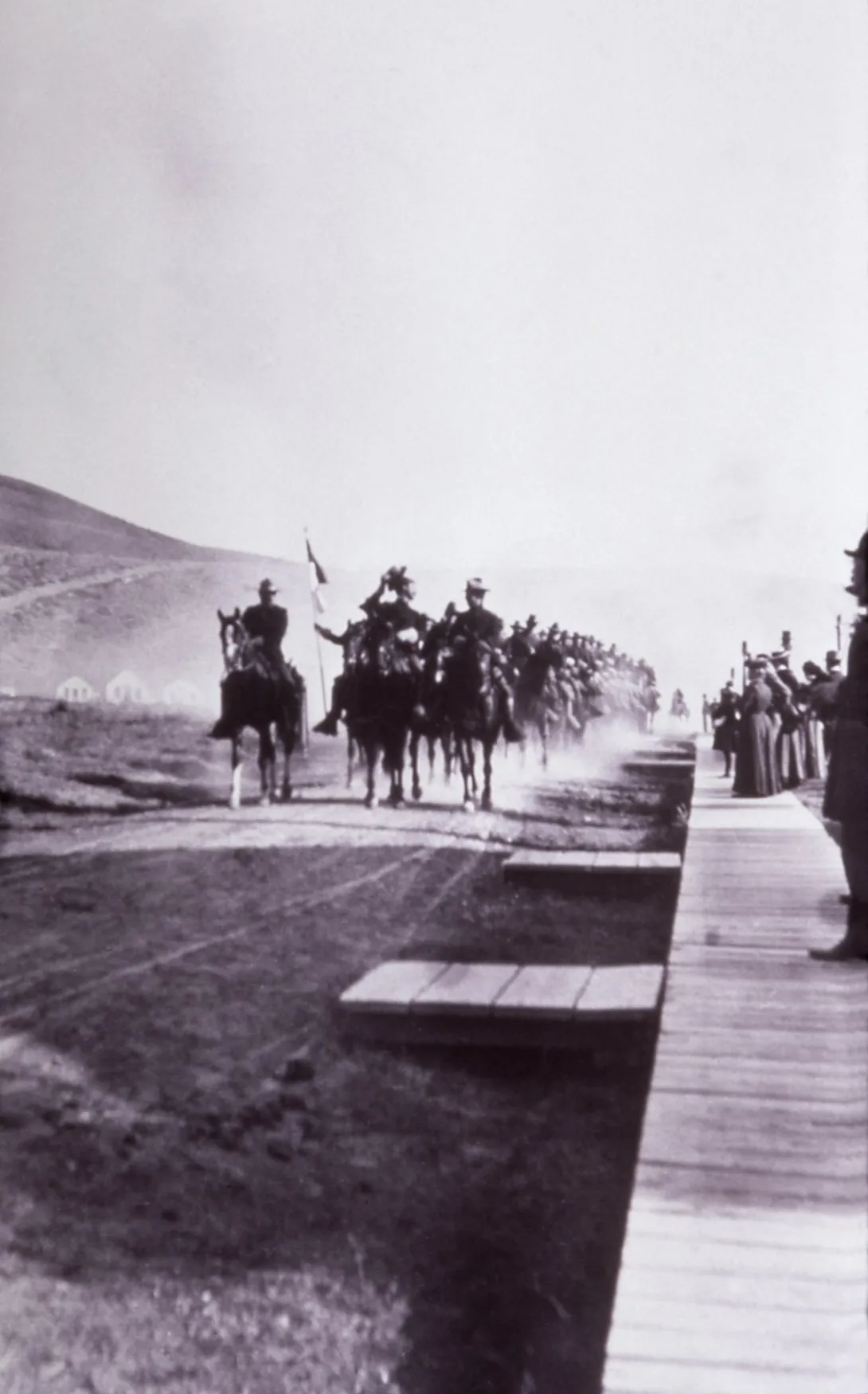
In August 1886, a column of cavalry rode into Mammoth Hot Springs and pitched its tents at the foot of the terraces. Company M of the First U.S. Cavalry, under Captain Moses Harris, had come from Fort Custer in Montana Territory to do what fourteen years of civilian superintendents could not: protect Yellowstone. The camp they called Camp Sheridan was meant to be temporary. The Army stayed for thirty-two years, and in that time it built the post, the patrol system, and the habits of enforcement on which the modern National Park Service still stands.
The summons came after Congress refused, once again, to fund a civilian administration in 1886. The Secretary of the Interior, invoking authority under the Sundry Civil Act of 1883, asked the War Department for help, and the War Department sent cavalry. The soldiers inherited a park under siege from poachers, souvenir hunters, and squatters, and they set about guarding it the military way: sentries at the geyser basins, patrols in the backcountry, and troublemakers escorted to the boundary. One limit frustrated them for years. Until Congress passed a protective law in 1894, a soldier who caught a poacher red-handed could confiscate his gear and expel him, but could not prosecute him. The Army's presence alone did not end poaching; law had to catch up with the patrols.
The post grew into permanence. In 1890 Congress appropriated $50,000 for a real fort, and on May 11, 1891, the post was formally named Fort Yellowstone. Its first buildings, a guardhouse first, then officers' quarters, a headquarters, barracks, and stables, were finished by late 1891. A second set of clapboard buildings in 1897 made it a two-troop post. From 1909, Scottish stonemasons raised the handsome sandstone buildings that still define Mammoth, including the Bachelor Officers' Quarters that visitors know today as the Albright Visitor Center, and raised the fort's capacity to 400 men in four troops. At its peak, in 1910, 324 soldiers were stationed at Fort Yellowstone, along with their families and a staff of civilian employees.
It was not a soft posting. Winter patrols crossed the park on skis in temperatures far below zero, and the same troopers who chased poachers in January were fighting forest fires and managing tourist traffic in August. With soldiers' families and civilian employees added, the post at its height was less a camp than a small town at the park's front gate. The work itself became the template for the ranger force that followed. Soldiers guarded the geysers and terraces against vandals, evicted troublemakers, fought forest fires, and patrolled hundreds of miles of backcountry on horseback in summer and on skis in winter, sleeping in a ring of patrol cabins. When the National Park Service was created in 1916, it had, in Yellowstone, a working model of what park protection looked like, and in October 1918 the Army formally handed the park over to the new civilian agency.
Thirty-five Army-era structures survive at Mammoth Hot Springs, and Fort Yellowstone is now a National Historic Landmark District that still serves as the park's headquarters. Visitors who walk past the red-roofed officers' row and the stone visitor center are walking through the cavalry's post. The campaign hats, the patrol cabins, the very idea of a uniformed guardian of the parks: all of it was rehearsed here, by soldiers, between 1886 and 1918.
Photo: Company M, 1st U.S. Cavalry, entering Mammoth Hot Springs, August 1886 — National Park Service.