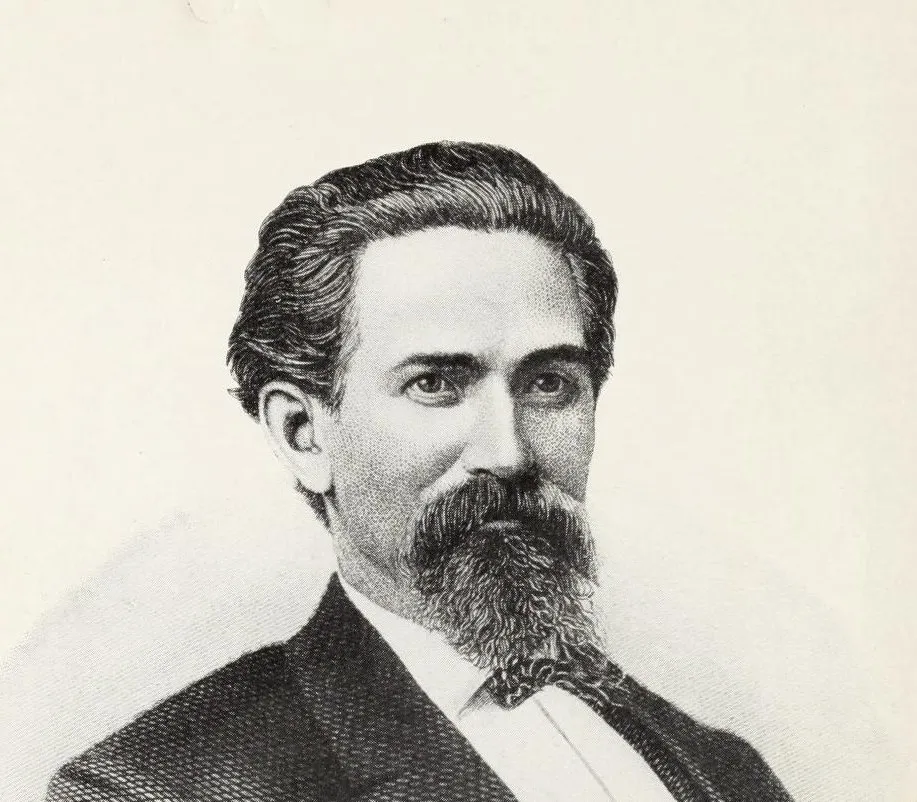
In the middle of August 1870, nine citizens of Montana Territory rode out of Helena to see whether the trappers' tales were true. They were not scientists or soldiers by trade. They were lawyers, bankers, merchants, and officials, led by Henry D. Washburn, the Surveyor-General of Montana Territory, and they had talked the Army into coming along. At Fort Ellis, near present-day Bozeman, they collected their escort: Lieutenant Gustavus C. Doane, one sergeant, and four privates of Company F, Second Cavalry, carrying thirty days' rations and a hundred rounds of ammunition per man. What that party found, and what its members did with what they found, changed American history.
The expedition worked its way south through the country that is now the northern half of Yellowstone. The men admired Tower Fall, climbed mountains to fix their bearings, and descended into the Grand Canyon of the Yellowstone to stand beside the great falls. They followed the eastern and southern shores of Yellowstone Lake, then turned west into the geyser basins: the Lower, the Midway, and finally the Upper Geyser Basin, where they camped among the most astonishing springs on Earth. There they watched one geyser erupt with such clockwork regularity, roughly once an hour, that they gave it the name it still carries: Old Faithful.
The expedition had no photographer, a fact worth remembering, because no photographs of the 1870 party in the field exist. Its record was made in words, and words turned out to be enough. Cornelius Hedges, a Helena lawyer on the trip, wrote articles for his hometown newspaper arguing that this remarkable region should be set aside as a national park rather than claimed and carved up by private interests. The idea was not entirely new; Thomas Francis Meagher, a former acting governor of the territory, had suggested something like it earlier. But Hedges and his companions gave the idea witnesses, evidence, and momentum.
Another member, Nathaniel P. Langford, became the expedition's traveling voice. In early 1871 he lectured on Yellowstone in the East, including a talk in Washington, D.C., on January 19, 1871, attended by the geologist Ferdinand V. Hayden. In May 1871, Langford's account appeared in Scribner's Monthly, and Lieutenant Doane's official report, a sober military document full of careful description, reached the Secretary of War. Together they carried Yellowstone to a national audience and set up the great Hayden survey of 1871, which returned with the photographs and paintings that finally moved Congress.
One part of the story must be told as what it is: a legend. Later accounts describe the explorers gathered around a campfire at Madison Junction on September 19, 1870, renouncing any personal claims to the wonders they had seen and resolving to seek a national park instead. It is a fine story, and it may even preserve a kernel of truth, but it first appeared in print decades after the event, most prominently in Langford's published diary of 1905, and historians aligned with the National Park Service treat it as embellishment rather than documented fact. The documented record needs no campfire: nine citizens went to look at a rumored wonderland, came home, and spent the next year persuading their country to protect it. The park their reports made possible still bears the name they gave its most famous geyser, and Old Faithful still keeps its appointments, roughly once an hour, just as it did for them.