Yellowstone had a credibility problem. For sixty years, everyone who described it sounded like a liar, and by 1871 the young science of geology decided to settle the matter with evidence. That spring, Congress appropriated $40,000 for Ferdinand V. Hayden's U.S. Geological and Geographical Survey of the Territories to explore the Yellowstone region, and Hayden did something no survey leader had done on this scale before: he took a photographer and a painter along, so that the country could speak for itself.
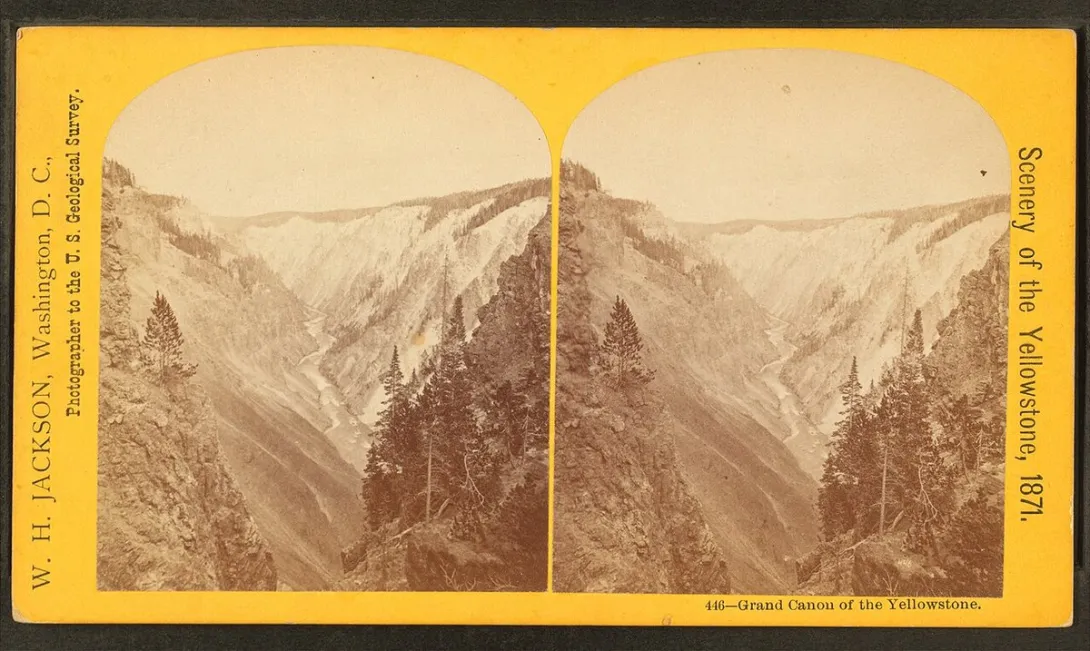
The party, roughly thirty-two men, left Ogden, Utah, on June 8, 1871, and worked through the Yellowstone country until early October. Its photographer was William Henry Jackson, the first photographer carried on a major federal survey of this kind. His outfit was a traveling laboratory: cameras, glass plates, chemicals, and a portable darkroom, several hundred pounds of fragile equipment hauled by pack mules over country with no roads. Every plate had to be coated, exposed, and developed in the field, often beside the very geyser or canyon it recorded. By the end of the season Jackson had produced more than 150 photographs in the large 8-by-10 format alone, plus stereographs, the first photographs of Yellowstone's terraces, canyon, and geysers ever seen by a wide national audience. The stereographs mattered as much as the large prints: viewed through the twin-lensed viewers that stood in parlors across America, they put Yellowstone's wonders, in three dimensions, on the nation's mantelpieces.
The painter was Thomas Moran, and his status was unusual: he came as a guest, not as the survey's official artist, a post held by Henry Wood Elliott. Moran's way was paid by Scribner's Monthly, which wanted illustrations, and by Northern Pacific financier Jay Cooke, who wanted dramatic western scenery to promote his railroad. He and Jackson, who had never met before the trip, fell into a working partnership, setting up at the same viewpoints side by side, the camera and the sketchbook recording the same terraces and falls. Moran documented more than thirty sites in field sketches and watercolors that summer.
That winter, Hayden's official report, Jackson's prints, and Moran's watercolors circulated in Washington, and in the National Park Service's words they helped inspire members of Congress who had never seen the area to pass the park bill. Two cautions belong with that famous story. Jackson's celebrated photograph of an Old Faithful eruption, often dated 1871, was actually made in 1872, on the second Hayden survey. And Moran's monumental oil painting of the Grand Canyon of the Yellowstone was finished after the act had passed; Congress bought it later in 1872 for the Capitol. What moved the legislators in the winter of 1871 and 1872 were the field watercolors, the sketches, and Jackson's prints, working alongside Hayden's report and, it must be admitted, the Northern Pacific's lobbying. The pictures did not act alone, but without them the words might never have been believed.
Visitors who stand at Artist Point or along the canyon rim today are looking at views that Jackson and Moran made famous before the park existed. The canyon they framed in 1871 is the canyon on a million postcards, and the survey that carried them there remains the model of what exploration is for: go, see, bring back proof, and let the country make its own case.
Photo: William Henry Jackson, 1871, Hayden Geological Survey — New York Public Library, via Wikimedia Commons.