In March 1894, in the deep snow of Pelican Valley, an Army scout named Felix Burgess followed a snowshoe trail to a cache of six bison scalps and skins. Burgess was patrolling alone, on skis, in one of the most remote corners of Yellowstone. He kept following the trail, and near Astringent Creek he came upon the man he was looking for: Edgar Howell of Cooke City, Montana, skinning a freshly killed bison, with five more carcasses lying around him. At least eleven of the park's bison had died on that one poaching trip. Burgess crossed the open ground on his skis and arrested the armed poacher at revolver point, without firing a shot. On March 14, 1894, Howell arrived under guard at the Fort Yellowstone guardhouse, and then the law, such as it was, ran out.
There was no law. For all the Army's patrols, no federal statute made it a crime to kill Yellowstone's wildlife, so the most the authorities could do to the most notorious poacher in the park was confiscate his outfit and expel him. Howell walked free, and everyone who cared about the park understood the obscenity of it, because the animals he was killing were nearly the last of their kind. That same March, a winter party led by the photographer F. Jay Haynes counted just 81 buffalo in Hayden Valley, 73 of them in a single herd. The wild bison of the United States had been reduced to a remnant, and a market hunter with a rifle could finish the job in a few more winters.
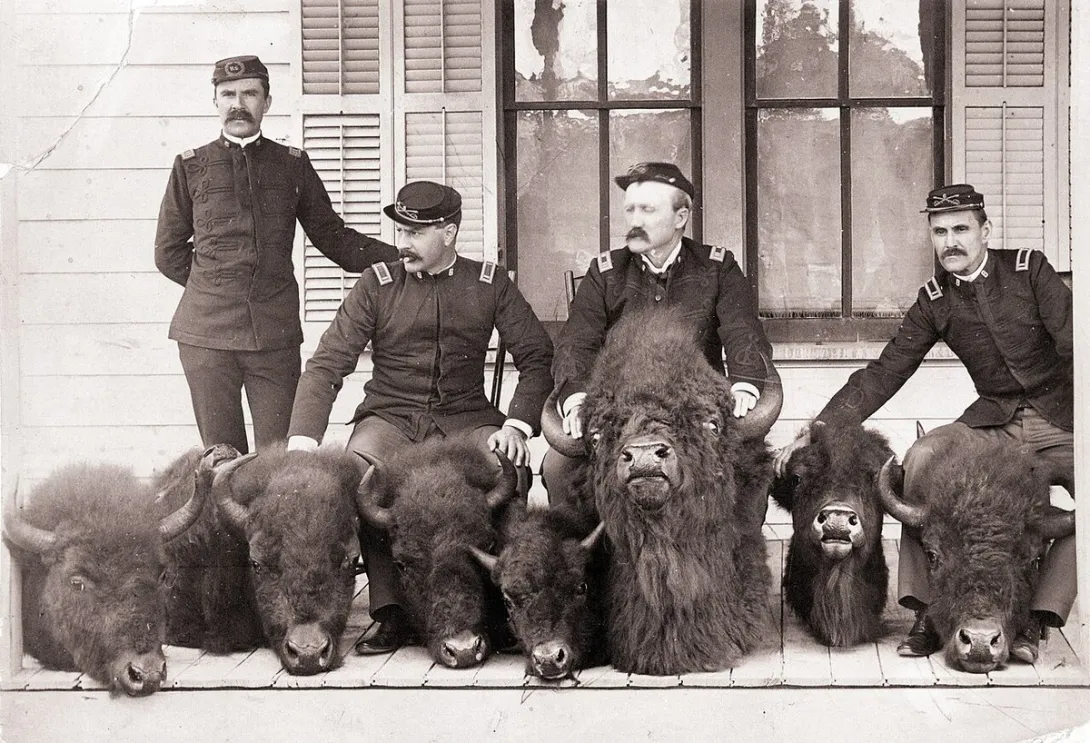
What saved the herd was publicity. By a stroke of fortune, the writer Emerson Hough was in the park that winter with Captain George Anderson's photographic expedition, Haynes included, and Hough reported Howell's capture for the sporting journal Forest and Stream. Its editor, George Bird Grinnell, filled his editorial columns with outrage and urged his readers to demand a law from Congress. A caution belongs here: some of the photographs the journal published with its Howell coverage, under captions like "The Butcher's Work," were recycled stock images rather than pictures of Howell's kill, as Smithsonian Libraries research has shown. The famous photograph of Fort Yellowstone officers posed with eight confiscated bison heads, however, is genuine, and it needed no embellishment.
Congress acted within about six weeks. In the spring of 1894 it passed the "Act to protect the birds and animals in Yellowstone National Park," championed by Representative John F. Lacey of Iowa and often called the Yellowstone Lacey Act. It made killing park wildlife a federal offense, punishable by fines and imprisonment, and extended Wyoming law into the park so that offenders could actually be tried. It should not be confused with the better-known Lacey Act of 1900, a different law by the same congressman that banned interstate transport of illegally taken wildlife. The 1894 act came too late to punish Howell himself, and any version of the story that has him tried under it is wrong. It came because of him, and in time to save what he was killing.
Visitors who watch bison by the thousand in the Lamar and Hayden Valleys today are looking at the descendants of the herd Howell hunted, protected by the legal machinery his arrest created. Every wildlife prosecution in the national parks descends from the spring of 1894, when one scout on skis did his job perfectly and discovered that the law could not. Congress fixed that, and Yellowstone's animals have had the law on their side ever since.
Photo: Officers of the Fort Yellowstone garrison with bison heads confiscated from poacher Ed Howell, 1894 — National Park Service, Yellowstone National Park archives (YELL 36953).