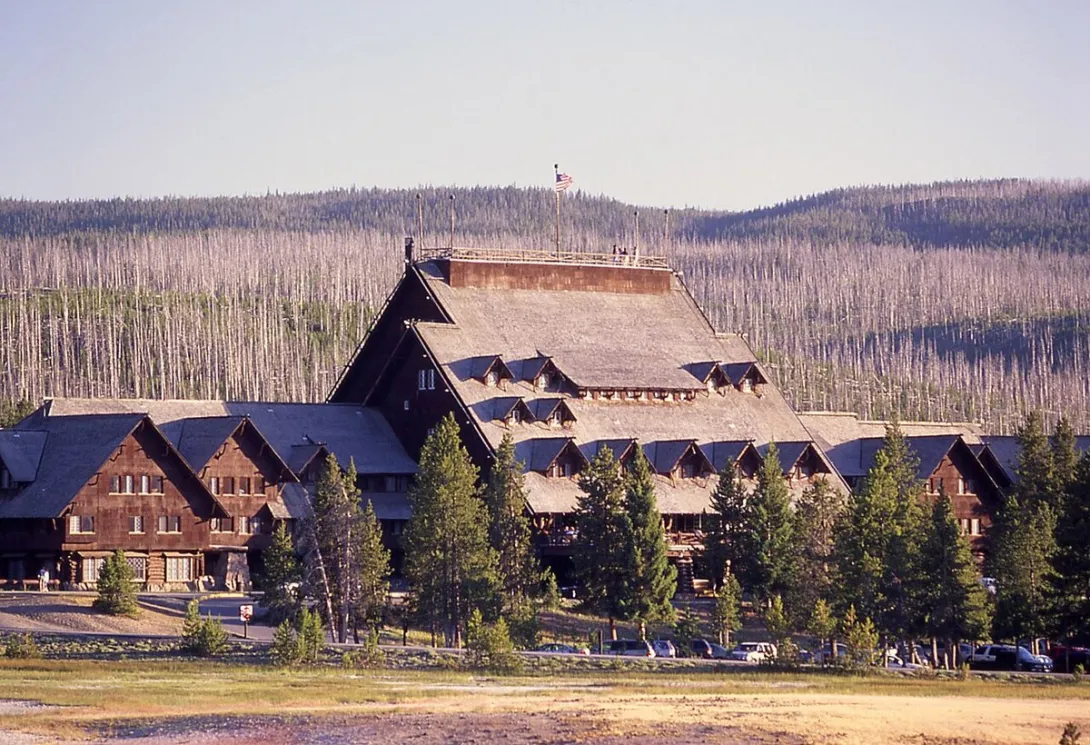
It was built in a single winter, in a geyser basin, out of the forest that surrounded it. The Old Faithful Inn opened in 1904 a short walk from the world's most famous geyser, and it was like nothing American travelers had ever slept in: a towering log palace with a lobby that soared some six stories to a steeply pitched roof, a stone fireplace built of volcanic rock, and gnarled pine branches for balustrades. The inn is considered the largest log structure in the world, and it became the prototype of the rustic architecture, later called National Park Rustic, or parkitecture, that defined how buildings would be made to belong in the parks.
The inn's architect was Robert C. Reamer, a 29-year-old working for the Yellowstone Park Company, whose president, Harry W. Child, obtained financing from the Northern Pacific Railroad in 1902. The basin needed a hotel. The old Upper Geyser Basin Hotel had burned down in 1894, leaving the Old Faithful area without a substantial hotel for a decade, and the railroad wanted a destination worthy of the journey. Reamer was not the first architect on the project; an 1898 Queen Anne design by A. W. Spalding had been approved and never built. Where Spalding had imagined a conventional resort hotel, Reamer imagined a building grown from the place itself.
Construction ran through the winter of 1903 and 1904, with crews working in deep snow and bitter cold. The materials came from the neighborhood: lodgepole pine logs for the frame and the twisted, characterful branches for the interior trim, and rhyolite, the stone of Yellowstone's own caldera, for the foundation and the great fireplace. The choice of materials was practical as well as poetic. Lodgepole pine stood in dense forest all around the basin, and rhyolite rubble lay at hand in the volcanic landscape, so the inn could rise quickly even at the end of a long and snowbound supply line. The total cost was about $140,000. When the inn opened, on June 1, 1904, by the hotel histories' account, it offered modern comforts in its rustic shell: electric light, from fixtures Reamer designed to look like candlesticks, and steam heat.
Reamer's relationship with his building lasted for decades. He supervised the additions himself, the east wing in 1919 and the west wing in 1927, which brought the inn to roughly 340 guest rooms while keeping its character intact. The building has been tested since. It survived the Hebgen Lake earthquake of 1959, magnitude 7.3, which damaged its roof and chimneys, and it survived the fires of 1988, when flames reached the Old Faithful complex and the inn was saved. The Old Faithful Historic District was listed on the National Register of Historic Places in 1982, and the inn itself was designated a National Historic Landmark in 1987.
Today the lobby fills with visitors at every eruption, watching the geyser through the inn's doors and gathering around the rhyolite fireplace much as guests did in 1904. Stand across the Firehole River and take in the whole improbable silhouette, the steep roof, the dormers, the crow's nest on top, and you are looking at the building that taught the national parks how to build: out of local stone and timber, at the scale of the landscape, and unmistakably of its place.
Photo: Old Faithful Inn, Yellowstone National Park — photo by Jim Peaco, National Park Service.