In the summer of 1877, Yellowstone National Park was five years old, barely administered, and almost entirely undefended. That August, into this unguarded park rode the most desperate travelers in its history: some 750 to 800 Nez Perce men, women, and children, with about 250 warriors and some 2,000 horses, fleeing the United States Army. The non-treaty bands of the Nez Perce, the Nimiipuu, had refused the treaty of 1863 that shrank their homeland, and when the government gave them thirty days in June 1877 to leave the Wallowa Valley of Oregon for a reservation in Idaho, they chose flight instead. Five months and roughly 1,170 miles later, the flight would end in the snow at Bear Paw, Montana. In between, it crossed Yellowstone.
The pursuit involved some 2,000 soldiers, and the running fight had already passed through the battles of White Bird Canyon on June 17, the Clearwater, and the Big Hole on August 9, where the Army struck the Nez Perce camp at dawn and the bands fought their way out. On August 23, 1877, the Nez Perce entered Yellowstone near today's west entrance, hoping, among other things, that the park's geysers and trackless forests might hide them, and that they could pass through and find allies among the Crow to the east.
Inside the park they encountered about 25 tourists, sightseers who had come to marvel at the new wonderland and found themselves in a war. Warriors captured or attacked several parties, and two visitors were killed. The bands forded the Yellowstone River at the place now called Nez Perce Ford, crossed Pelican Valley and the Hoodoo Basin, and escaped over the Absaroka Mountains, feinting toward Clarks Fork Canyon to throw off the pursuit. The Crow alliance they had hoped for never came. Denied refuge, they turned north for Canada and the protection of the border.
The end came on October 5, 1877, at Bear Paw, less than forty miles from Canada, where Chief Joseph surrendered, while some 300 people under White Bird escaped across the border. The words attached to that surrender, "From where the sun now stands, I will fight no more forever," come down through the transcription of Lieutenant Charles Erskine Scott Wood, an aide to General Howard, and their exact wording is disputed; the National Park Service itself hedges them as what Joseph is believed to have said. The same care applies to Joseph's role. He was not the flight's sole leader or its battlefield strategist, as the newspapers of the day claimed in calling him a "Red Napoleon." Leadership was shared among Joseph, Looking Glass, White Bird, Ollokot, and Toohoolhoolzote, and Joseph's own part leaned toward the leadership of the camp and the care of its people, which in a flight of families was no small command.
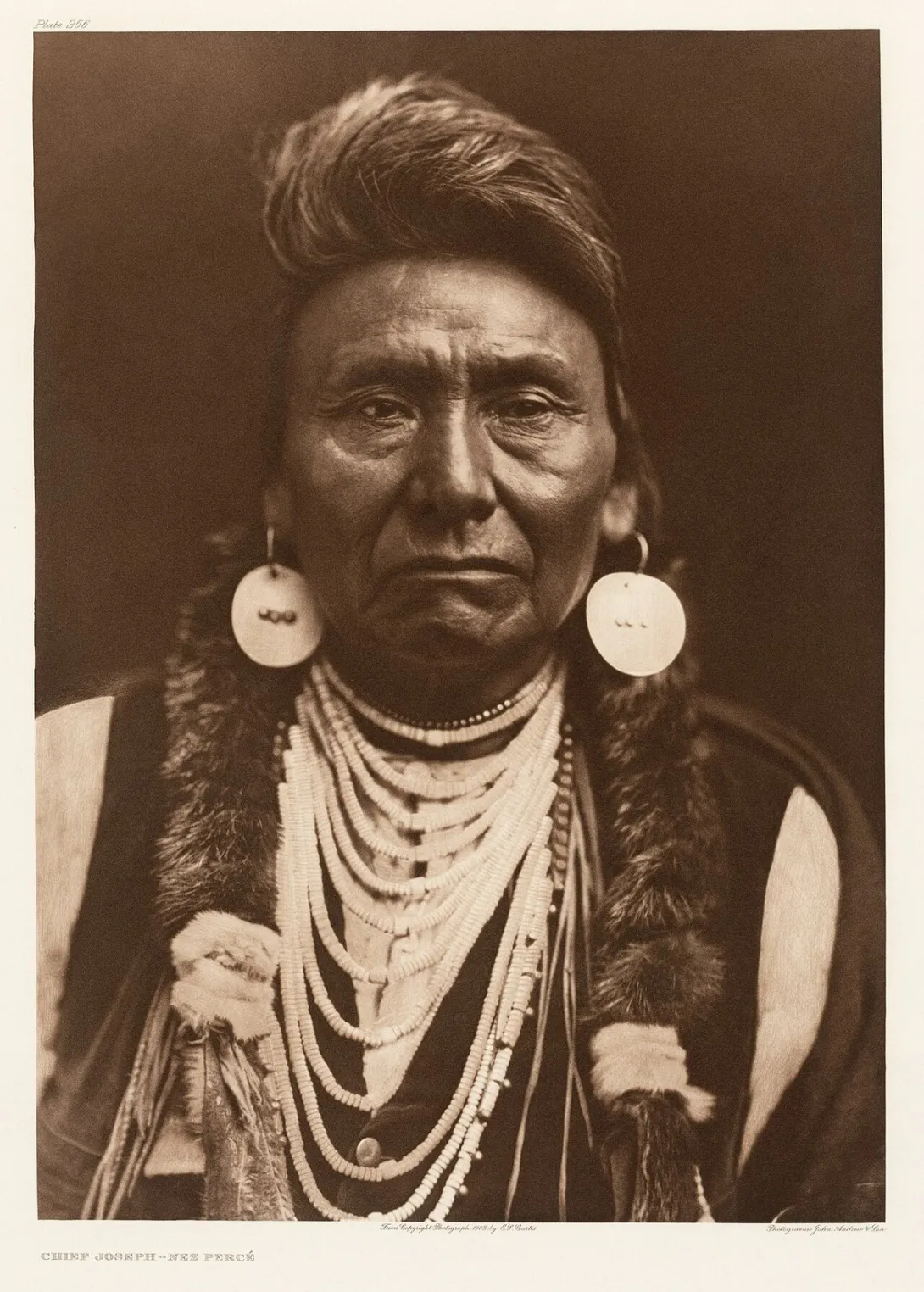
Visitors cross the Nez Perce route today without knowing it, at Nez Perce Ford on the Yellowstone River and along the trails of Pelican Valley. The park keeps the memory in its place names, and the Nez Perce National Historic Trail preserves the whole arc of the flight. Joseph lived until 1904; the famous portrait of him by Edward S. Curtis was made in 1903, twenty-six years after the flight, showing an elder statesman of a cause already lost. The young park he crossed in 1877 has been a refuge for many things since. In that summer it was, briefly and unwillingly, a corridor of war, and the people who crossed it were fighting to keep a homeland the way the park's animals would later fight to keep theirs: against the whole weight of a changing country.
Photo: Chief Joseph of the Nez Perce, photographed by Edward S. Curtis, 1903 — Smithsonian National Portrait Gallery, via Wikimedia Commons.