Long before Yellowstone became a national park in 1872, people had already known this country for more than 11,000 years. Set where the Great Plains, Great Basin, and Columbia Plateau cultures meet, the Yellowstone plateau was a place to hunt, fish, gather plants, quarry obsidian, and use thermal waters for religious and medicinal purposes. The National Park Service counts 27 tribes with historic or present-day ties to the park, and tribal traditions remember it in vivid terms: to the Kiowa, Dragon's Mouth Spring at Mud Volcano was where their creator gave them this land for a home, a story the Crow also tell about the feature.
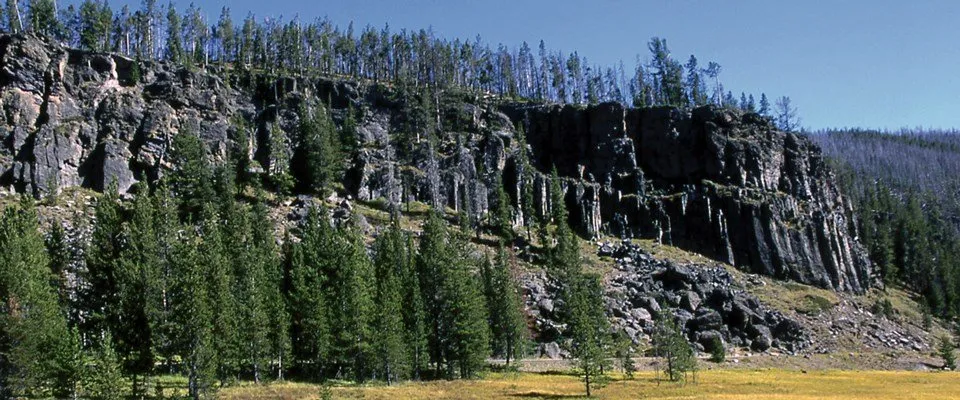
Click to see more photos of Obsidian Cliff
Among all those peoples, one group made Yellowstone itself home. The Tukudika, a band of Mountain Shoshone, lived for thousands of years in the country that became the park, across what is now northwestern Wyoming, southwestern Montana, and eastern Idaho. Their name means eaters of the mountain sheep, a nod to the bighorn sheep that was their primary source of meat, though at least half their diet came from plants, roots, nuts, and berries. Traveling in extended family groups along the rivers and streams, they moved to higher country in summer and lower elevations in winter, and the Shoshone-Bannock Tribes say some families stayed in the park year-round.
Did you know the Tukudika turned Yellowstone's heat and stone into tools famous across the West? At Obsidian Cliff they quarried volcanic glass in family groups, digging pits with shovels made from bison or elk bone — archaeologists have studied more than 50 quarries there — and worked the stone with elk antlers, getting two or three arrowheads from a cantaloupe-sized rock. For their bows, they soaked bighorn sheep horns in geothermal waters until the horns softened, then shaped them into strong, durable bows that other tribes sought in trade throughout the Rocky Mountains and Northern Plains. Their sheepskin clothing was another prized trade good.
Unlike most neighboring peoples, the Tukudika never adopted the horse. They kept hunting on foot in steep alpine country, helped by medium to large dogs that pulled travois loaded with game or belongings and were close companions. They built drive lines and corrals for bighorn sheep, set fish traps of stone and timber, cooked and stored food in bowls carved from soft steatite, and sheltered in curved lodgepole and grass houses called newe-gahni, built snug against rock faces. When fur trapper Osborne Russell met a small Tukudika group in the Lamar Valley in 1835, he described them favorably, even as many later accounts overlooked their deep knowledge of this landscape.
The Tukudika remained in the Yellowstone country for several years after the park was created. By 1900 they had been incorporated into the Eastern Shoshone of the Wind River Reservation in Wyoming and the Shoshone and Bannock tribes of the Fort Hall Reservation in Idaho, where removal brought the partial collapse of their traditional lifeways. Their descendants live on both reservations today, and some prefer the name Mountain People, for its emphasis on place rather than food. It is a fitting name for the people who knew Yellowstone's mountains, hot springs, and obsidian longest and best.
Photo: Obsidian Cliff, Yellowstone National Park — National Park Service.