Did you know that for more than thirty years, the classic Yellowstone vacation began not with a car key, but with a train ticket and a seat on a horse-drawn coach? In the park's earliest years, getting there was an expedition in itself. In the early 1870s, visitors rode the railroad only as far as Corrine, Utah, then continued by stagecoach toward Virginia City, Montana, or they traveled up the Missouri River to Fort Benton and came south by stage. Everything changed in 1883, when the Northern Pacific Railroad reached Cinnabar, Montana, near the park's north entrance, and a stage line was created to carry passengers from the rail terminal into and through Yellowstone.
Click to see more photos of Yellowstone's Tally-Ho stagecoaches
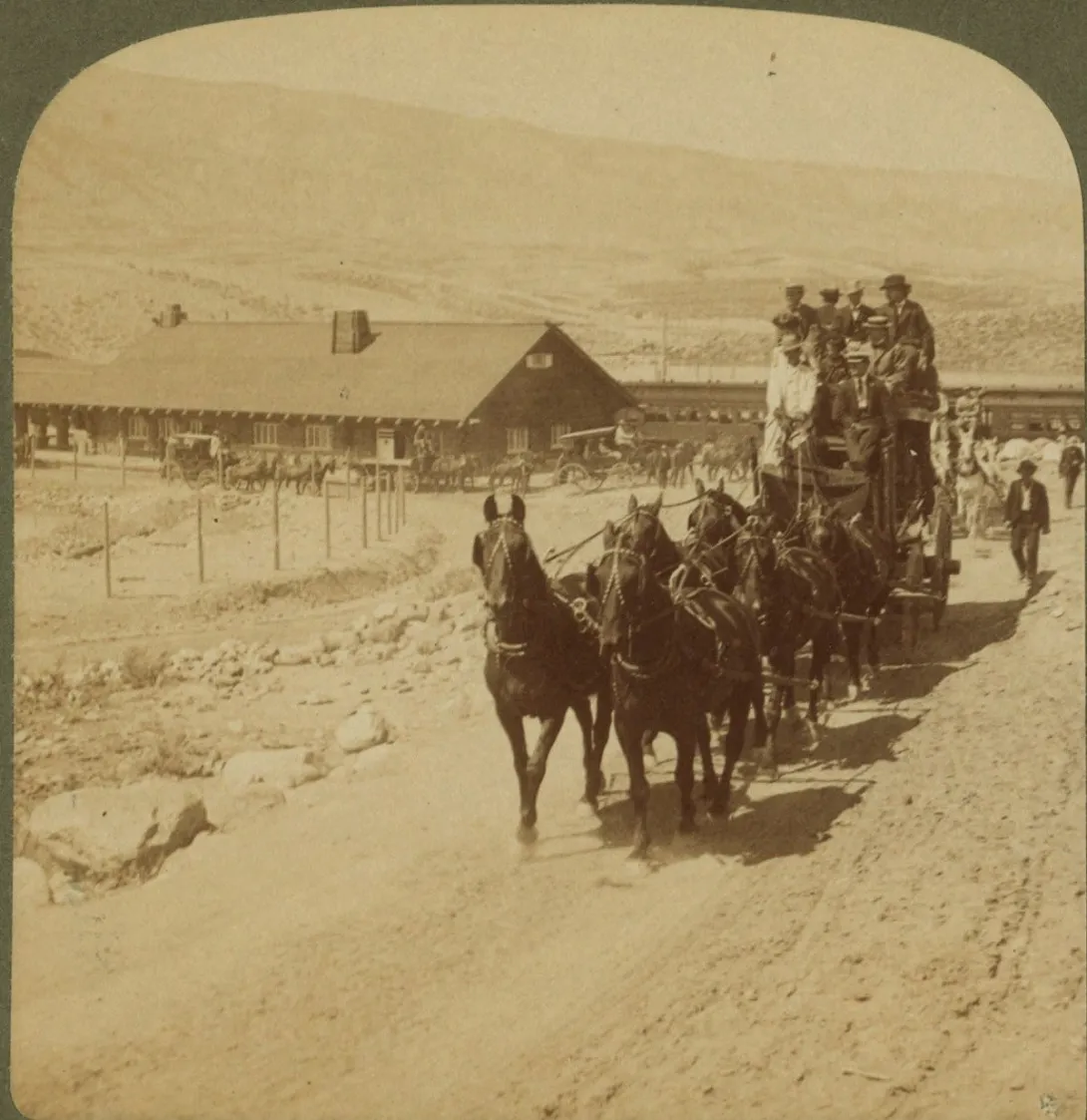
The arrival ritual became part of the adventure. Travelers stepped down from the train, climbed aboard a large six-horse coach called a Tally-Ho, and rattled up the scenic Gardner Canyon to Mammoth Hot Springs. In 1903 the railroad extended its line from Cinnabar to Gardiner itself, where the depot stood near the Roosevelt Arch, and Cinnabar was abandoned. By 1886 the transportation company already had a fleet of sightseeing vehicles, the most popular of them Yellowstone coaches painted bright yellow and built by the Abbot-Downing Company of Concord, New Hampshire. The roof seats of the Tally-Ho were reportedly the most sought after by visitors, and from the hotel at Mammoth, guests transferred to smaller four-horse Yellowstone observation wagons for the Grand Loop tour through the park.
The grand tour was a carefully staged journey of about six days. After a first night at the National Hotel at Mammoth Hot Springs and a look at the travertine terraces, parties spent the next four days bouncing along in their wagons, which sometimes had to be unloaded on steep grades so the horses could pull them up. Each night brought a warm bed and a lavish meal at a grand hotel, and each day brought another wonder, from the geyser basins to the canyon and the lake. The drivers were characters in their own right, with nicknames like Crying Jack and Society Red, and they kept their passengers entertained with frontier-style stories about the park. The trips were not without risk, either: slow-moving coaches full of affluent tourists made easy targets for robbers.
Not everyone traveled in grand style. The Wylie Permanent Camping Company, which operated from 1883 to 1917, and the Shaw and Powell Camping Company, from 1898 to 1916, offered a less expensive guided trip on mountain stage wagons, with nights in permanent camps, comfortable raised tents, and hearty meals in dining tents. Thriftier visitors came in their own covered wagons; these sagebrushers camped along the roadsides and fished the rivers and lakes for their suppers. Meanwhile, Army engineer Major Hiram Chittenden was rebuilding the park's roads, and by 1905 he had finished the roughly 300-mile, figure-eight road system that still connects Yellowstone's entrances and major attractions today.
A second railroad era opened in 1908, when Union Pacific service began at West Yellowstone, Montana. That line became the quickest route to Old Faithful and the Upper Geyser Basin, and it kept running until 1960, the last railroad line operating to a park entrance. By then the stagecoach age was long over: the first automobiles were admitted to Yellowstone in 1915, and in 1917 private and commercial horse-drawn conveyances were banned from park roads. The yellow coaches disappeared into museums, but the pattern they created, a great loop road linking hotels, geysers, canyon, and lake, is still the journey millions of visitors follow every summer.
Photo: A six-horse Tally-Ho stagecoach leaving Gardiner, Montana, for a trip through Yellowstone Park, with the railroad depot behind it. Underwood and Underwood, New York Public Library Digital Collections, via Wikimedia Commons (public domain).