Skip to header Skip to main navigation Skip to main content Skip to footer
Home
History of Yellowstone National Park
Stories From the World's First National Park

Main navigation

  • Home
  • Articles
  • Business Directory
  • Dining
  • History
  • Lodging
  • Outdoors
  • Shopping
  • Things to Do
  • Weather
  • Webcams

Articles

By Train and Tally-Ho: Yellowstone in the Grand Tour Era
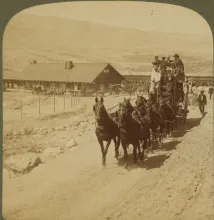
A six-horse Tally-Ho stagecoach carrying tourists on its roof seats leaves Gardiner, Montana, for a tour of Yellowstone Park, with the railroad depot and a train in the background

Did you know that for more than thirty years, the classic Yellowstone vacation began not with a car key, but with a train ticket and a seat on a horse-drawn coach? In the park's earliest years, getting there was an expedition in itself. In the early 1870s, visitors rode the railroad only as far as Corrine, Utah, then continued by stagecoach toward Virginia City, Montana, or they traveled up the Missouri River to Fort Benton and came south by stage.
  • Read more about By Train and Tally-Ho: Yellowstone in the Grand Tour Era

The Mountain People: The Tukudika and Indigenous Yellowstone

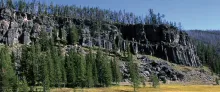
Obsidian Cliff in Yellowstone National Park, the dark volcanic glass cliff quarried for thousands of years by the Tukudika and other tribes.

Long before Yellowstone became a national park in 1872, people had already known this country for more than 11,000 years. Set where the Great Plains, Great Basin, and Columbia Plateau cultures meet, the Yellowstone plateau was a place to hunt, fish, gather plants, quarry obsidian, and use thermal waters for religious and medicinal purposes.

  • Read more about The Mountain People: The Tukudika and Indigenous Yellowstone

Three Men Alone: The Cook-Folsom-Peterson Expedition of 1869

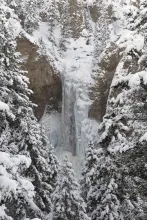
Tower Fall in winter in Yellowstone National Park, photographed in December 2015

In the fall of 1869, Yellowstone was still a rumor. Mountain men told of boiling springs, a canyon cut deep into yellow rock, and a great lake high in the mountains, but few people in Montana Territory had seen those wonders for themselves and lived to describe them clearly. That September, three working men from Diamond City, a gold camp in Confederate Gulch east of Helena, decided to go and look. They were David E. Folsom, Charles W. Cook, and William Peterson, and their journey would become the first organized expedition to explore the region that became Yellowstone National Park.

  • Read more about Three Men Alone: The Cook-Folsom-Peterson Expedition of 1869

The Nez Perce Flight Through Yellowstone, 1877

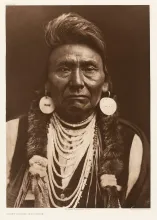
Edward S. Curtis's 1903 portrait of Chief Joseph of the Nez Perce, made twenty-six years after the flight of 1877.

In the summer of 1877, Yellowstone National Park was five years old, barely administered, and almost entirely undefended. That August, into this unguarded park rode the most desperate travelers in its history: some 750 to 800 Nez Perce men, women, and children, with about 250 warriors and some 2,000 horses, fleeing the United States Army.

  • Read more about The Nez Perce Flight Through Yellowstone, 1877

The Wolves Return: Yellowstone, 1995-1996

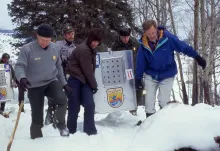
Crated wolves being carried to an acclimation pen in Yellowstone in January 1995, at the start of the wolf reintroduction.

On January 12, 1995, the first eight gray wolves to set foot in Yellowstone in nearly seventy years arrived in crates, carried through the Roosevelt Arch in a small convoy. Wolves had been deliberately eradicated from the park by 1926, the last of them killed under the era's federal predator-control program, and for two generations the great predator's absence had been official policy. Now the policy had reversed itself. The wolves were going home, and hundreds of people had gathered in the cold to watch them come through the arch.

  • Read more about The Wolves Return: Yellowstone, 1995-1996

The Roosevelt Arch: A Stone Gateway and a Promise

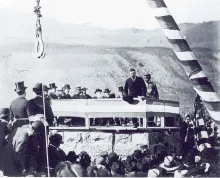
President Theodore Roosevelt speaking at the cornerstone ceremony for the Roosevelt Arch at Gardiner, Montana, on April 24, 1903.

Every national park needs a front door, and in 1903 Yellowstone built one out of stone. The Roosevelt Arch rises about 52 feet over the road at Gardiner, Montana, where the five-mile drive to headquarters at Mammoth Hot Springs begins. Across its top, in letters meant to be read from a wagon or a train platform, runs a promise: "For the Benefit and Enjoyment of the People." Those words are a quotation, and getting their source right matters.

  • Read more about The Roosevelt Arch: A Stone Gateway and a Promise

The Old Faithful Inn: A Log Palace Beside the Geyser

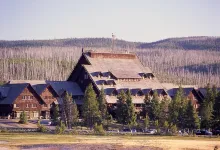
The main facade of the Old Faithful Inn, built in 1904 of lodgepole pine and rhyolite stone beside the Old Faithful geyser.

It was built in a single winter, in a geyser basin, out of the forest that surrounded it. The Old Faithful Inn opened in 1904 a short walk from the world's most famous geyser, and it was like nothing American travelers had ever slept in: a towering log palace with a lobby that soared some six stories to a steeply pitched roof, a stone fireplace built of volcanic rock, and gnarled pine branches for balustrades.

  • Read more about The Old Faithful Inn: A Log Palace Beside the Geyser

The Poacher Who Changed the Law: Ed Howell and the Act of 1894

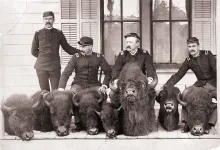
Fort Yellowstone officers posed in 1894 with eight bison heads confiscated from the poacher Ed Howell.

In March 1894, in the deep snow of Pelican Valley, an Army scout named Felix Burgess followed a snowshoe trail to a cache of six bison scalps and skins. Burgess was patrolling alone, on skis, in one of the most remote corners of Yellowstone. He kept following the trail, and near Astringent Creek he came upon the man he was looking for: Edgar Howell of Cooke City, Montana, skinning a freshly killed bison, with five more carcasses lying around him. At least eleven of the park's bison had died on that one poaching trip.

  • Read more about The Poacher Who Changed the Law: Ed Howell and the Act of 1894

Nathaniel P. Langford: A Superintendent Without a Salary

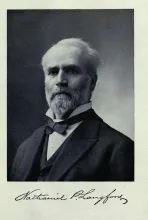
Portrait of Nathaniel P. Langford, Yellowstone's first superintendent, as published in his 1905 history of the park's discovery.

When Yellowstone National Park was created in March 1872, Congress gave it a superintendent and nothing else: no salary, no operating funds, and no staff. The man who accepted that impossible job was Nathaniel P. Langford, a veteran of the Washburn expedition of 1870 and one of the park's most effective public advocates. Secretary of the Interior Columbus Delano appointed him in May 1872, and Langford, who received the notification on May 10, accepted knowing full well that the position paid nothing.

  • Read more about Nathaniel P. Langford: A Superintendent Without a Salary

Pictures That Made a Park: Jackson, Moran, and the Hayden Survey of 1871

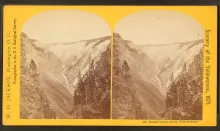
William Henry Jackson's 1871 photograph of the Grand Canyon of the Yellowstone, made during the Hayden Geological Survey.

Yellowstone had a credibility problem. For sixty years, everyone who described it sounded like a liar, and by 1871 the young science of geology decided to settle the matter with evidence. That spring, Congress appropriated $40,000 for Ferdinand V. Hayden's U.S. Geological and Geographical Survey of the Territories to explore the Yellowstone region, and Hayden did something no survey leader had done on this scale before: he took a photographer and a painter along, so that the country could speak for itself.

  • Read more about Pictures That Made a Park: Jackson, Moran, and the Hayden Survey of 1871

Pagination

  • Current page 1
  • Page 2
  • Next page ››
  • Last page Last »

Yellowstone Weather — Mammoth Hot Springs

Loading current conditions...

Loading forecast...

Upcoming Events

Yellowstone Events Calendar

This week in Yellowstone:

  • See the park calendar for current programs and any scheduled events.

Copyright © 2026 Rocky Mountain Madman LLC - All rights reserved

Developed and Designed by Rocky Mountain Madman LLC